Neon Tester
Neon Tester

Frequently Asked Questions
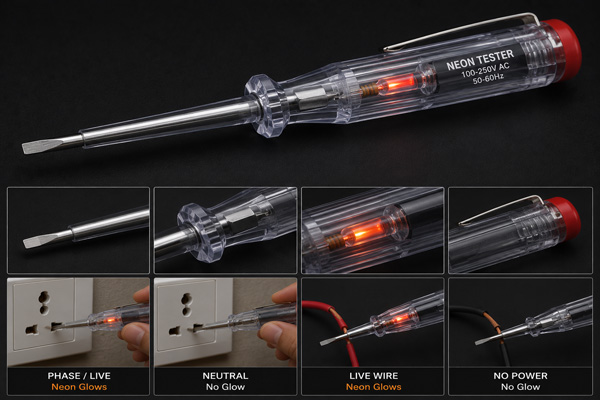
A neon tester, also known as a test lamp or line tester, is a simple hand tool used to check whether an electrical wire, socket, or point is live by illuminating a small neon bulb when current is detected.
When the metal tip of the tester touches a live conductor and the user holds the top contact, a small amount of current flows through an internal resistor and neon bulb, causing it to glow and confirm the presence of voltage.
Neon testers are generally designed for standard household and low-voltage AC circuits; they should not be used on high-voltage industrial lines without a tester specifically rated for that voltage range, as this can pose a serious safety risk.
A neon tester gives a simple visual glow to indicate live wires without showing exact voltage, whereas a digital voltage tester provides a precise numerical voltage reading along with additional features like continuity testing and non-contact detection.
Basic neon testers are primarily designed for live-wire detection and are not typically built for continuity testing; a multimeter or dedicated continuity tester is more suitable for that purpose.
Users should always hold the tester by its insulated handle, avoid touching the metal tip directly, ensure the tool is in good working condition, and never rely on it as the sole method of confirming a circuit is de-energized before maintenance work.
They are widely used by electricians, panel technicians, and homeowners for quick checks of switches, sockets, wiring points, and fuse boxes in residential, commercial, and light industrial settings.
Yes, we supply neon testers in bulk to electrical contractors, hardware distributors, OEMs, and industrial buyers across Gujarat and India, including export orders. For pricing and details, contact us at +91 90237 59007, +91 81405 50607, or shreeshivaelectric@gmail.com.