Analog Meter
Analog Meter

Frequently Asked Questions
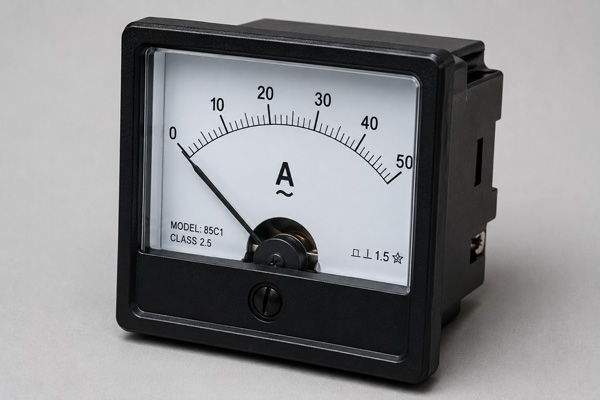
An analog meter is a measuring instrument that uses a mechanical needle moving across a printed scale to indicate values such as voltage, current, or power, with the reading determined by the needle's position relative to the calibrated markings.
Most analog meters use a moving-coil or moving-iron mechanism, where the electrical signal passing through an internal coil generates a magnetic force that deflects the needle proportionally to the strength of the input being measured.
Analog meters allow users to visually track fluctuating or trending values more intuitively through needle movement, and they generally don't require a power source to operate, making them reliable for basic field measurements.
Depending on the model, analog meters can measure voltage (voltmeter), current (ammeter), resistance (ohmmeter), or a combination of these parameters in a single multi-range unit.
Since values are read visually based on needle position against a scale, slight parallax error or scale misjudgment can occur, requiring careful eye alignment for precise readings compared to a direct numeric digital display.
Yes, many technicians still prefer analog meters for applications like tuning circuits or monitoring gradual changes, as the continuous needle motion can show trends and fluctuations more naturally than a digital readout.
Analog meters are typically available in standard panel cutout sizes such as 96x96mm, 72x72mm, and 48x48mm, making them easy to integrate into existing switchgear and control panel layouts.
Yes, we supply analog meters in bulk to panel manufacturers, switchgear assemblers, OEMs, and industrial buyers across Gujarat and India, including export orders. For pricing and details, contact us at +91 90237 59007, +91 81405 50607, or shreeshivaelectric@gmail.com.